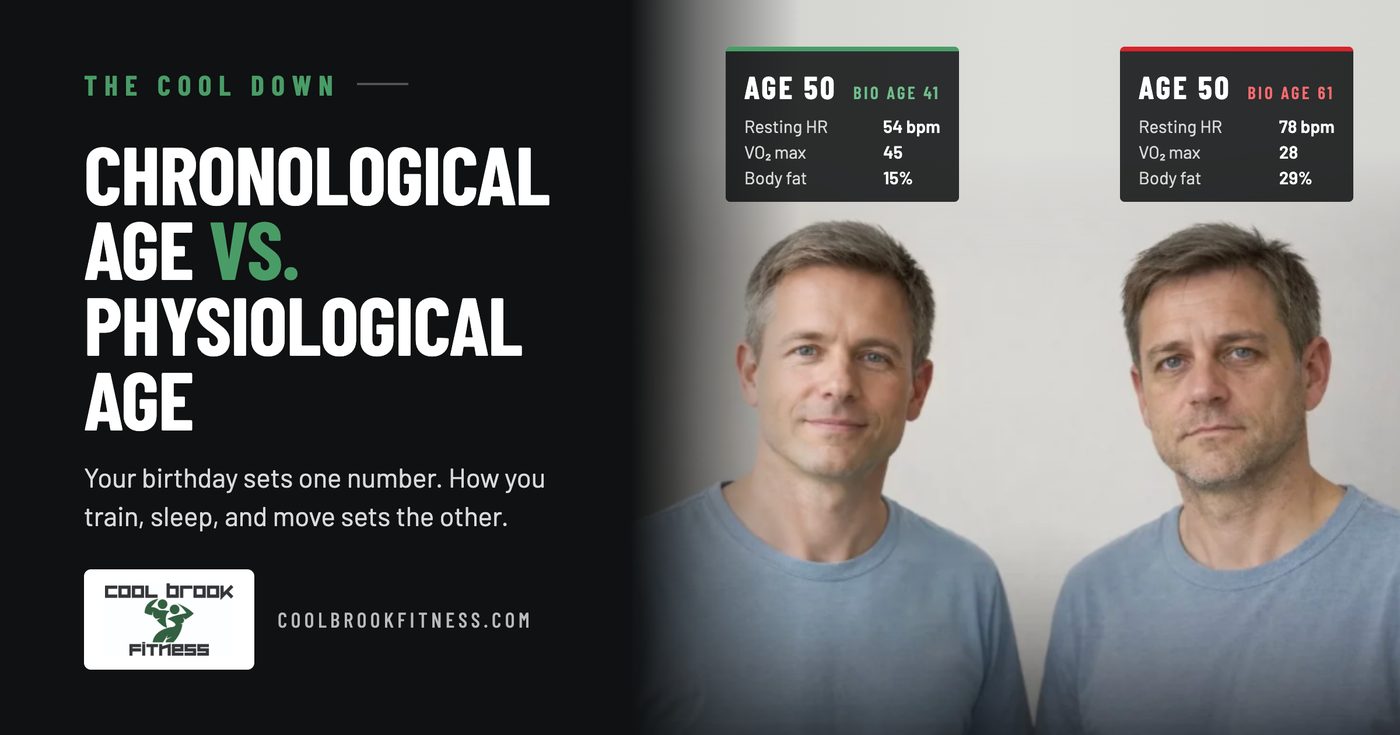
Here's some math you can't argue with: you turn one year older every single year, no matter what you do about it. Your chronological age is fixed, non-negotiable, and frankly none of your business to control. But here's the part that should get you fired up — your physiological age, meaning how well your body actually functions (your joint mobility, muscle mass, VO2 max, recovery capacity, metabolic health) is a completely different story, and it's largely in your hands. Two 50-year-olds can have wildly different physiological ages depending on how they've trained, slept, eaten, and moved for the last few decades. That's not a guilt trip — it's genuinely amazing news, because it means the damage isn't necessarily permanent.
The best part is you don't need a biohacking lab or a subscription to a longevity newsletter to move the needle — the basics still win. Daily hydration, real nutrition choices, plenty of low-intensity movement, and consistent strength training are still the highest-leverage tools we have for turning back your physiological clock. Strength training in particular deserves the spotlight here — it's one of the few interventions proven to preserve muscle mass, bone density, and functional independence as you age.
This is exactly why personal training matters so much as you get older: a personal trainer or fitness coach can build fitness programs (including smart speed training with a speed coach, because power and speed decline faster than strength does) that specifically target the markers that make you biologically younger, not just calendar-older. If you're in Goleta or Santa Barbara and want help attacking your physiological age instead of just counting birthdays, that's exactly what we do at Cool Brook Fitness.